Give clear instructions (Early Childhood)
teaching practiceFor student year
Helps students to
- know what is expected
- practice and perform tasks effectively
Helps teachers to
- promote independence
- provide clarity and predictability
- use less verbal repetition
Summary
In busy environments, many young learners, including neurodivergent learners, benefit from clear and explicit instructions in order to respond readily and appropriately. Challenges with social communication, interaction, expressive and/or receptive language can impact learners’ ability to focus on instructions and understand what is required of them. Some diverse learners need concrete language and/or visual prompts to understand exactly what the educator wants them to do. Clear instructions support learners in feeling confident that they are doing the right thing.
How the practice works
Watch this video to learn more about giving clear instructions within the classroom.
Duration: 2:47
Australian Children’s Education and Care Quality Authority (ACECQA) National Quality Standards (NQS) related to this practice
Element 1.1.2: Child centred
Each child’s current knowledge, strengths, ideas, culture, abilities and interests are the foundation of the program
Element 1.1.3: Program learning opportunities
All aspects of the program, including routines, are organised in ways that maximise opportunities for each child’s learning.
Element 1.2.1: Intentional teaching
Educators are deliberate, purposeful, and thoughtful in their decisions and actions.
For further information, see ACEQA’s National Quality Standard page
Early Years Learning Framework (EYLF) outcomes related to this practice
Outcome 4: Children are confident and involved learners
Outcome 5: Children are effective communicators
For further information, see ACEQA’s Approved learning frameworks page
Preparing to teach
As early childhood educators we provide a lot of direction to the children in our care over the course of an activity, session, and day.
Good instructions need to be clear, especially for young children, and learners need processing time, which means we need to pause and wait. Phrasing instructions as statements and not requests indicates your expectation that these instructions will be followed. For example, you can request a learner join in on a group activity by stating, "Time to join the group for music, Ali" rather than "Would you like to join your group now?"
Clear directions:
- start by ensuring you have the child/ren’s attention
- are short, specific statements
- include a verb so the child knows the action they must do
- tell learners what they are expected to do
- tell learners how they are expected to do it
- are followed by a 5-10 second pause by you, the educator.
By pausing you provide:
- learners with the time needed to process the direction
- yourself with an opportunity to check for attention and understanding.
Choose a verbal and/or non-verbal cue to gain attention e.g., “1, 2, 3… listen to me”. Choose one that matches your style – it can become one of your teaching ‘signatures’.
To prepare appropriate adjustments to the instructions you give, it is important that you understand the communication strengths and needs of your learners. Particularly relevant is knowing which learners are visual learners or have learning needs that include:
- auditory processing and planning
- organising
- task initiation.
When giving directions, you should refer to visual supports. These will support learners’ processing and task initiation.
Longer instructions
Instructions provide learners with the basic information needed to complete the required task: who? — what? — when? — where? — why? — how? The complexity of your instructions will depend on the development of the child or children you’re working with.
Consider if longer instructions should be displayed visually (such as using pictures/images) - verbal instructions disappear as soon as they are given, and lengthy verbal instructions are difficult for young children to remember or follow. Simple visual instructions mean your learners are more likely to follow them in order.
When giving instructions, do not give all of the information at once. Chunk your instructions into smaller segments that are specific and short.
Prepare the following supports before they’re needed, and have them in place and within easy reach for reference:
- rules (e.g. “We walk inside” – tells the children what to do, rather than “Don’t run” that tells them what not to do)
- schedules (e.g. daily calendar of activities – mat time, blocks, puzzles, snack, outdoors)
- routines (e.g. First-Then – “First we wash hands, then we have our snack”)
- task sequences (e.g. sequence of washing hands routine before lunch – Turn on tap, squirt on soap, rub and scrub)
- organisational checklists (e.g. packing your bag ready to go home)
Communication style
Be aware of your own communication style and the capacity of your learners to understand. Instructions should be short, specific, and include a verb. You may need to write out and/or rehearse optimal ways to deliver clear short instructions. Reflect and monitor if these instructions are working.
When giving instructions, use non-verbal cues in a consistent way. Give directions:
- from the same place (if a group instruction)
- using the same focused facial expression
- using the same gesture (e.g. to indicate ‘come here’ or ‘sit down’)
It works better if:
- you move close and get down to the child’s level for individual instructions
- you refer to visual materials
- use the same verbal and non-verbal cue
- you are calm and consistent
It doesn’t work if:
- instructions are too long - chunk down for easier processing
- you give instructions without first gaining learner attention
- you continue talking while waiting and scanning for learner attention
- you do not reference visual materials
- the instructions don’t match the child’s age or developmental stage.
In the classroom
Step 1. Observe and check
- Observe the child’s pre-requisite skills and their current responses to adult instructions (strengths and needs). You could also ask parents/carers and other specialists about the child’s response to instructions and what works well in other environments.
- Make sure other distractions are reduced wherever possible, e.g., auditory or visual distractions, such as music playing
- Minimise competing demands on learner’s attention, e.g., if learners are engaged in group play, approach the groups individually, and ask them to stop what they are doing to await next instructions.
Step 2. Gain attention
- Use the attention-gaining strategy you have chosen e.g. "1, 2, 3… listen to me", or a nonverbal strategy (such as one hand in the air which indicates learners should be quiet and put their hand in the air as well)
- Wait
- Scan for attention.
Step 3. Give instruction
- Give the intended instruction
- Use a firm, clear, and calm voice (not speaking too fast)
- Refer to whole-group and/or individualised visual materials, if relevant
- Wait
- Scan for understanding.
Step 4. Scaffold further
- Prompt learner to begin following the direction
- If you can see a learner is not following the directive, use short, concrete language to explain the next step
- Refer again to whole-group and/or individualised visual support.
Step 5. Acknowledge
- Provide feedback to learners who followed, or tried hard to follow, the direction. This can be verbal ("Good job!") or nonverbal (thumbs up, smile, high-five). Specific verbal feedback is a good way to reinforce acknowledge that the learner has followed the direction as requested (e.g. “Great listening Shaima. You sat on the mat when I asked you to”)
Step 6. Review
- Review if the desired outcome to the instruction is achieved or if the instructions given need altering
- Check if further supplementary visual supports (e.g., “first-then” cards or checklists) will support learners to focus on and follow instructions as independently as possible.
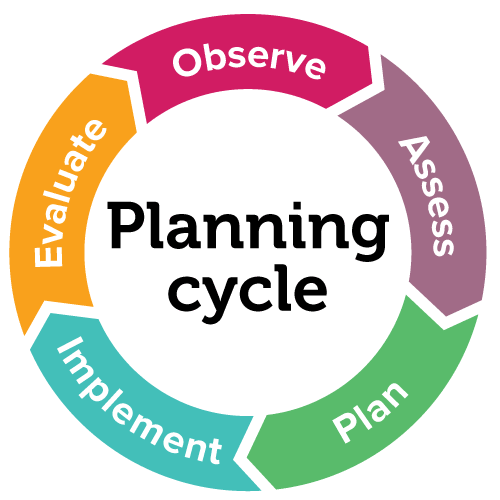
Use the EYLF Planning Cycle
- Observe: routines and activities where the child responds positively to adult instructions and when they are experiences difficulty. Observe what strategies are most effective. Observe other adults who have success with effective instructions and consider what makes their approach work well.
- Assess: ask parents/carers and any specialists about what works best in supporting the child to respond appropriately to instructions in other environments where the child lives, learns and plays
- Plan: how to embed clear instructions into the child’s daily routine at ECEC. Establish individualised goals with the parents/carers and other specialists that may be involved
- Implement: your plan to support the child respond appropriately to adult instructions
- Evaluate: the impact of strategies on the child’s learning and behaviour to inform future planning.
How will I know if it's working?
- Learners follow instructions without prompting
- Learners independently follow instructions
- Educators embed clear, consistent instructions into their daily practice
Practice toolkit
Practice implementation planner template
We know it's not always easy to keep track of what's working and what isn't. So, we've created this template for you to record and reflect on what you're doing to create more inclusive classrooms. The implementation planner contains:
- guidance around goal setting
- a reflection section (what worked, didn’t work, what to change, and next steps)
- prompting questions.
Implementation planner with examples
 Download
 Set your professional learning goal for:
Give clear instructions (Early Childhood)
Benefits of goal setting
Setting, working towards, and reflecting on goals helps you grow professionally and improve your practice. You can access AITSL learning resources for teachers to learn more about:How to set goals
The Australian Institute for Teaching and School Leadership recommends using the SMART matrix to frame your goal setting.SMART goals refers to goals that are:
- Specific
- Measurable
- Achievable
- Relevant
- Time-phased
Resources
Related Practices

Consistently use routines and schedules (Early Childhood)
TEACHING PRACTICE
For student years
Helps students to
- feel less anxious
- transition smoothly
- know what is coming next

Learning Cycle