For student year
Helps students to
- stay motivated
- remain on-task for longer
- feel valued
Helps teachers to
- facilitate learning
- regularly check behaviour
- identify concerns
Summary
Feedback in the early years is essential for young learners to understand expectations and instil lifelong learning habits. Instructional feedback is an encouraging response that you give your learners directly in relation to their on-task performance, learning or behaviour.
In this practice, you will read about why feedback is important and will revisit how to make it:
- meaningful
- motivating and
- constructive.
How the practice works
Watch the video to learn more about this practice.
Duration: 3:42
Australian Children’s Education and Care Quality Authority (ACECQA) National Quality Standards (NQS) related to this practice
Element 1.2.2: Responsive teaching and scaffolding
Educators respond to children’s ideas and play and extend children’s learning through open-ended questions, interactions and feedback.
Element 5.1.1: Positive educator to child interactions
Responsive and meaningful interactions build trusting relationships which engage and support each child to feel secure, confident and included.
For further information, see ACEQA’s National Quality Standard page
Early Years Learning Framework outcomes related to this practice
Outcome 2: Children are connected with and contribute to their world
Outcome 4: Children are confident and involved learners
For further information, see ACEQA’s Approved learning frameworks page
Preparing to teach
The value of feedback
Appropriate and timely feedback has a positive impact on learners':
- attitude
- engagement
- motivation
- behaviour
- learning
- sense of achievement.
Effective feedback provides the learner with information on:
- where they are going (their goal)
- how they are going
- where to go next.
The feedback you give your learner should be meaningful, timely and communicated effectively. Quality feedback is completely objective. As Wiggins (1998) states:
"Feedback is not about praise or blame, approval or disapproval. That’s what evaluation is – placing value. Feedback is value-neutral. It describes what you did and did not do.”
Types of feedback
Descriptive encouraging
Descriptive encouraging is a process of describing exactly what you can see or hear from a learner that you hope to see more frequently, thereby highlighting their competence and abilities. This can sound like, "I can see you are being very careful with colouring in the lines" or "I like that you keep asking questions when you're not sure.” By acknowledging positive learning behaviours, you provide feedback that the behaviour is desired and increase the likelihood of it occurring again.
Instructional feedback
Instructional feedback focuses on a cycle of cue, learner action, and teacher feedback. The teacher provides a cue for learning or behaviour (e.g., "When we do craft, we use soft voices"), followed by a learner action, and then teacher feedback in response (e.g., "Let's soften those voices just a bit more so we don't disturb others"). Instructional feedback may curb challenging behaviours and increase learner engagement.
Remember
- Know and consider the abilities, characteristics, and preferences of each child. This will make your feedback personalised and positive.
- Identify one aspect of the task or behaviour that the child has done well, and one that could be done better or differently.
- Pair feedback with a reinforcer such as a high-five, handshake, personalised message or token (if using a reinforcing system such as token economies).
- Feedback can also be non-verbal - from a simple thumbs up to using a visual reward chart.
Before you start
- Reflect on and review your instructional and feedback procedures, together with communication/interaction styles, to see what you would like to focus on.
- Develop and plan responsive and flexible feedback procedures appropriate to each lesson/topic that:
- is more frequent
- provides highly specific guidance
- provides specific feedback
- provides specific rewards.
- Consider if you would like to set up a token economy. A token economy is a system designed to reinforce desirable behaviour and learning. Tokens are small rewards that can be used to motivate learners during less-preferred tasks and activities.
Prior to the lesson choose, prepare and implement supporting visual resources such as:
- positively worded classroom rules
- directive visual supports, such as first/then visuals
- cumulative reward systems
It works better if:
- visual supports are in place and used as reference points for guidance and feedback.
- you focus on specific outcomes and expectation.
- you give feedback that is non-evaluative, immediate, enthusiastic, and varied.
- you accompany it with highly motivating reinforcers/rewards.
It doesn’t work if:
- there are no visual behaviour rules or visual learning supports in place.
- learning-based behaviour expectations are inconsistent.
- feedback is not linked to the immediate task.
- feedback focuses only on errors, offers no solutions, is negative or unvaried.
- reinforcing/token systems are unmotivating or are used to deduct points/rewards previously earned.
In the classroom
How do I do it?
Step 1: At the start
Refer to the supporting visual resources.
Make the intended learning clear and explicit. Remember it might be:
- performance
- learning
- behaviour
Proactively and explicitly explain the behaviour expectations with reference to visual rules. For example, “Everybody wash hands before we get our lunch” or “At play time today I’d like to see lots of sharing and taking turns”.
Use tokens during less-preferred tasks and activities.
Step 2: During
Actively monitor learner progress during the activity.
Observe for examples of good performance, learning or behaviour and provide learners with positive and varied feedback that is immediate and logically linked to the task or behaviour you hope to see.
When you observe examples of performance, learning, or behaviour which could be improved, provide descriptive encouraging to set the learner back on the right track. Provide positive suggestions for improvement in terms of task expectations or learning-based behaviour. Scaffold task performance if necessary.
Positively review and summarise learners’ performance, emphasising successes, suggesting improvements for next time, and allocating motivating rewards via the reinforcing system.
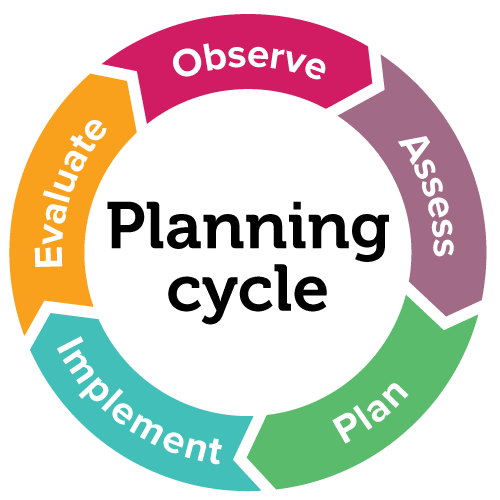
Use the EYLF Planning Cycle to provide feedback on learning and behaviour
- Observe: when your learner needs additional feedback to complete a task and take note of what specific activities they need support in
- Assess: whether descriptive encouraging or instructional feedback will be appropriate for this child
- Plan: how you can incorporate frequent and meaningful feedback into activities
- Implement: your plan by explicitly directing feedback to learners in need of additional verbal direction or encouragement
- Evaluate: any changes to the child’s competency and enthusiasm in completing activities after using feedback
How will I know if it’s working?
- The frequency of the appropriate on-task behaviour increases over time.
- The learner can demonstrate learned skills in response to feedback.
- The learner displays more confidence in their abilities.
Practice toolkit
Set your professional learning goal for:
Provide feedback on learning & behaviour (Early Childhood)
Benefits of goal setting
Setting, working towards, and reflecting on goals helps you grow professionally and improve your practice. You can access AITSL learning resources for teachers to learn more about:How to set goals
The Australian Institute for Teaching and School Leadership recommends using the SMART matrix to frame your goal setting.SMART goals refers to goals that are:
- Specific
- Measurable
- Achievable
- Relevant
- Time-phased
Related Practices
Engage families with effective communication (Early Childhood)
TEACHING PRACTICE
For student years
Helps students to
- be supported across settings
- have their voice heard

Model emotional literacy (Early Childhood)
TEACHING PRACTICE
For student years
Helps students to
- feel secure and included
- identify and respond to emotions
- regulate emotion
This practice is from the core research project
Learning Cycle