Provide a safe calm space for students (Secondary)
teaching practiceFor student year
Helps students to
- learn self-regulation
- reduce behavioural dysregulation
Helps teachers to
- create a calm space
- support the student
Summary
For the primary school version of this practice, go to:
Providing a safe calm space for students (Primary)
For some students, including neurodivergent learners, the sensory environment, academic demands, executive functioning requirements, and social aspects of school can be overwhelming and lead to distress, confusion, and potentially unexpected behavioural responses.
To mitigate the possibility of overwhelm, students may need support to regulate their emotions. It is important students are supported in regulating themselves before they become dysregulated (unable to regulate their emotions or behaviour). One way of supporting your students is to provide a safe calm space where they can retreat to self-regulate.
Providing a safe calm space is especially helpful for year 7 neurodivergent students and autistic students who may feel overwhelmed with the changes involved with starting high school. Because secondary students move between classrooms, it’s important to work with other subject teachers and your school’s wellbeing team to come up with an appropriate place for students to retreat to if the need arises.
It’s also essential to have a plan for students to re-enter the classroom once they’re ready. This could involve providing an empty table and chair at the back of the room that a student can access without drawing attention to themselves or disrupting the lesson.
To implement a safe space or home base, it’s important to be proactive not reactive.
How the practice works
Watch this video to learn more about this practice.
Duration 3:54
Australian Professional Standards for Teachers related to this practice
1.6 - strategies to support the full participation of students with disability
4.3 - manage challenging behaviour
For further information, see Australian Professional Standards for Teachers AITSL page
Preparing to teach
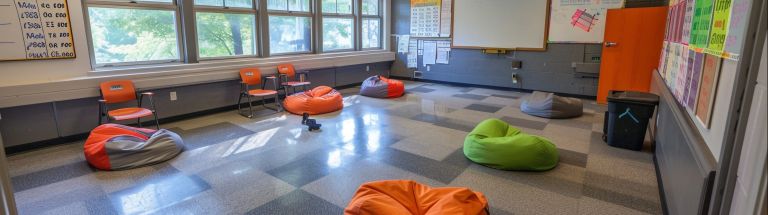
Some students have sensory needs that impact the amount of sensory input and social interaction that's required from them or that they require for optimal learning. A ‘safe space’ (or calm space or home base) is a predetermined location where students can go to take a break from situations they find demanding or stressful.
Recommendations from the National Guidance
Supporting the development and use of a calm space is one of the Recommendations from the National Guidance for best practice in inclusive education for autistic students (Section 5, Recommendation 39: Designate specific, safe, and accessible spaces within the school environment where autistic students can go when they need time to regulate, decompress, or manage sensory overload.) There is also an emphasis on creating emotionally safe environments (Recommendation 12: Enable autistic students to be their authentic selves by creating emotionally safe, predictable school environments).
Be proactive
To successfully implement a calm space, it is important to be proactive. The first planning step is to identify students who may become overwhelmed and could benefit from using a calm space. Meet with the student when they are calm and discuss what options may be appropriate for the space. It's important to discuss, clarify, and agree on specific points:
- under what circumstances it's appropriate to use the calm space
- how the student can request a calm space e.g. handing over a card, raising their hand
- how the teacher can subtly signal to suggest the calm space if they see the student struggling
- the location of the calm space. It's important the student views the calm space as positive and calming, so involve them in choosing the location and ensure the space is away from highly visible areas in order to protect the students’ privacy and dignity.
- how long the student stays in the calm space
- whether the student is expected to take their work with them.
During this meeting, it's important to:
- teach the student how and when to use the calm space e.g. through modelling and role play
- ensure you include any visual supports or cue cards, such as a break card, when the student is learning to use the calm space.
Creating a space with the student gives them a sense of agency to meet their own regulation needs at a time when they may feel vulnerable. It is essential that everyone involved understands that the calm space is to support the student and not a punishment. Ensure the space is a functional and purposeful area where students can engage in movement, quiet time, sensory input, and emotional regulation in ways they prefer and for the time they need. This might mean providing sensory equipment in the space that meets their sensory needs, such as headphones and self-regulation aids.
Review regularly
It's important to check in with the student regularly to ensure the calm space is working for both you and the student. It is also worthwhile to consider any adjustments that may be necessary.
Make sure all staff know the student has approval to use the calm space and how to support them. Ensure these spaces are not used for behaviour management and are instead used for the purpose of self-regulation.
Provide alternative safe options
Consider other calm spaces you can develop in the school – determine if there is scope to create inclusive clubs, programs or supervised spaces (e.g., chess club, quiet library space) during break times which means students with sensory processing difficulties can escape the busy and noisy playground areas.
These spaces can provide a safe and proactive solution to potential bullying or harassment that many neurodivergent students experience. It also provides a safe space for older autistic students to build peer relationships in a structured space, and engage in areas of special interest that works as a self-regulation tool.
It works better if:
- the teacher and student proactively agree on where the calm space is and how to notify the teacher before the student needs to use it.
- the calm space has appropriate sensory tools and self-regulation tools to support students to manage overwhelm.
- the student is able to take classroom work with them so the calm space doesn't become a way of avoiding class work.
It doesn’t work if:
- the teacher uses the calm space as a punishment or to exclude the student from classroom activities. The space should have a positive association.
- the student is required to ask for permission verbally to use calm space – sometimes students may feel too overwhelmed to verbally ask permission.
- the calm space isn't located somewhere that's calming for the student.
- the student consistently uses the calm space to avoid doing classroom work – this might require a conversation about capabilities and the work they complete.
In the classroom
How do I do it?
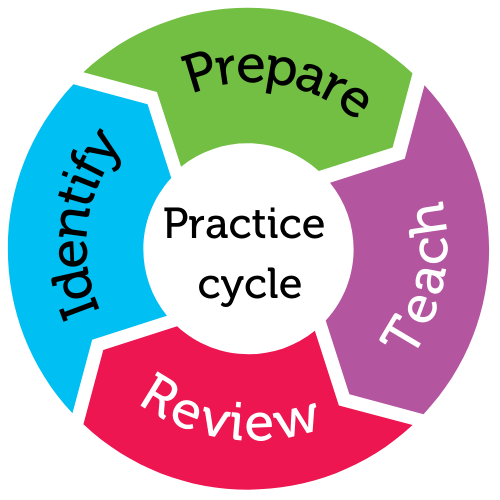
- Identify a student who could benefit from using the calm space.
- Consult with the student and agree on a location for the calm space.
- Agree with the student how they'll notify the teacher when they need to use the calm space, e.g., break card.
- Create a plan to support the student to re-enter the classroom that doesn't draw attention to them or disrupt the lesson.
- Decide on other specifics relating to the use of calm space, e.g., the maximum amount of time spent in the calm space and if the student needs to do work when in the calm space.
- Implement the calm space as agreed with the student.
- Reflect on the use of the calm space and make suitable adjustments as necessary.
Practice toolkit
Practice implementation planner template
We know it's not always easy to keep track of what's working and what isn't. So, we've created this template for you to record and reflect on what you're doing to create more inclusive classrooms. The implementation planner contains:
- guidance around goal setting
- a reflection section (what worked, didn’t work, what to change, and next steps)
- prompting questions.
Implementation planner with examples
 Download
 Set your professional learning goal for:
Provide a safe calm space for students (Secondary)
Benefits of goal setting
Setting, working towards, and reflecting on goals helps you grow professionally and improve your practice. You can access AITSL learning resources for teachers to learn more about:How to set goals
The Australian Institute for Teaching and School Leadership recommends using the SMART matrix to frame your goal setting.SMART goals refers to goals that are:
- Specific
- Measurable
- Achievable
- Relevant
- Time-phased
Resources
Break Card Examples
Some examples of Break Cards and some questions you can use to help create them
 Download
Related Practices
Provide a safe calm space for students
TEACHING PRACTICE
For student years
Helps students to
- learn self-regulation
- reduce behavioural dysregulation

Strengthen school belonging and emotional trust
TEACHING PRACTICE
For student years
Helps students to
- feel connected
- feel valued

Use visual supports to increase understanding
TEACHING PRACTICE
For student years
Helps students to
- learn new concepts
- follow lengthy instructions

Learning Cycle